HMRI President and CEO Leads by Example
Dr. Julia Bradsher’s Values Align to her Legacy Gift for HMRI
Many people have left a gift in their will or trust to organizations, like HMRI, that they care deeply about. Through these gifts, they continue their legacy of support, ensuring the mission of these organizations for years to come. President and CEO, Julia Bradsher, recently updated her estate plan, and included a gift to HMRI. Her passion for the organization will now continue long after she is gone. Julia sat down with respected Pasadena attorney Karl Swaidan to discuss her gift and planned giving.
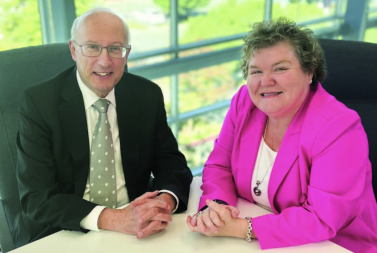
Attorney Karl Swaidan, partner of Hahn and Hahn and HMRI president and CEO Julia Bradsher meet to discuss the impact of legacy giving.
Julia: Could you talk generally about planned giving, also known as legacy giving, and how it fits into part of an estate plan?
Karl: Planned giving, in my mind, is a process that is done thoughtfully and carefully. It is a way to further the charitable goals of an individual or a couple. Those goals can be fulfilled either during their lifetime or upon death and should be done in a tax-efficient manner. Planned giving as a part of an estate plan can play an important role not only because it has a tax component but it may also help to articulate what the client wishes to have in the way of charitable goals. Many times, that is not fully developed, and I can help clients with that.
Julia: You know, that’s a nice segue into something I would like to put into context. I myself have established a planned gift here at HMRI. It’s part of an overall planned giving strategy and estate plan I’m implementing for myself for when I pass. For me, personally, I believe in leaving a legacy, and there are two areas of interest I’ve identified. One is scientific leadership for women, and the second is supporting young people as they navigate their careers, especially in science. And so, one of the things I did was establish a gift to HMRI that would support those efforts.
Julia: I’m curious: how do you help your clients align their charitable goals with how they want to give, considering their charitable intentions and values?
Karl: By serving as a facilitator, I help explain to them the kinds of choices that are available, considering tax consequences and their financial circumstances. I help them articulate what those goals are. You’ve done an excellent job because you have already articulated those goals. You did this very well because they are specific and emphasize the importance to you. For my clients, after they’ve articulated their goals, I give them a certain set of choices that will help develop and further those goals. After they’ve picked a charitable organization, there are then certain techniques from the tax side that are helpful from a financial perspective that also accomplish what they are looking for in the way of charitable goals.
Julia: In your experience, how have you seen alignment happen between a donor’s intentions, values, and a planned gift?
Karl: Usually, what you see is someone has a close friend or themselves or others in the family has had a certain life event. Sometimes it’s a medical issue, sometimes it’s something else. Once that occurs, that focuses people’s attention on what’s important to them. One of the most frequent events we see these days is the onset of Alzheimer’s disease, and I understand that HMRI has a big role to play in that research. And so, that immediately highlights for people an important reason to support an organization.
Julia: At what point does the nonprofit get involved?
Karl: Many times, clients come in and say, “I already know who I want to support, and I’ve already contacted that charity. They’re offering me certain approaches; could you
please review those for me so I understand them completely?” These approaches may be a charitable remainder trust, a charitable gift annuity, or perhaps a residence life estate with the
remainder going to charity. Many times, clients hear all of these, but sometimes they would like some help.
On the other hand, it can also occur post-death. I have many clients who do not necessarily want the charity to know that they are in their plan. Some are happy to have the charity know they
are included in their plan because they might like to have the acknowledgment during their lifetime or to perhaps help other people donate to the organization. If it happens on the tail end,
the charity then comes in later, and then they have the ability to assist with the donation. As we administer a trust or probate, they are able to then work with us, and we want to make sure
they get the bequest that they’re entitled to.
Julia: Is there anything else you want to discuss about planned giving?
Karl: Set your goals, get trusted advisors, and look at your assets. You’ve got to make sure you’re going to be taken care of during a lifetime and that your family is taken care of. When it comes to charitable organizations and planned giving, first, be careful; second, be thoughtful; third, be meaningful; and lastly, work alongside your advisor to make sure you’re being helpful to the nonprofit.
Attorney Karl Swaidan is a partner at Hahn and Hahn, an admired law firm and leader in California and business communities. Additionally, Karl is a certified taxation law specialist and a certified public accountant. His practice focuses on business, estate, and property tax planning; advising private foundations and charitable organizations as well as assisting closely held family businesses with tax planning.
Contact our team for expert guidance on a personalized legacy gift for HMRI.
Leave a Legacy, Impact the Future of Human Health
By including HMRI in your will, trust, or other plan, you will leave an enduring impact on biomedical research in Pasadena. You will join many other supporters as members of the HMRI Legacy Society. Through their foresight and generosity, Legacy Society members play a pivotal role in ensuring groundbreaking research continues for generations to come. Members are celebrated and recognized at HMRI events and programs throughout the year.
There are many ways you can leave a legacy gift to help you achieve your goals, including life income and tax-efficient estate planning. Below you will find more information on easy ways to create a legacy of support with HMRI.
If you already have left a gift to HMRI, please let us know using the contact us button below so we can thank you.
Our team is here to help you with personalized assistance and guidance.
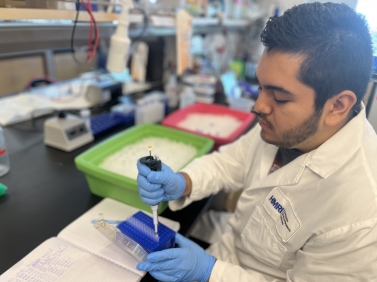
We are extremely thankful for your gifts, large and small. Your legacy gift to HMRI will propel biomedical research forward and ensure a brighter, healthier, and more hopeful future. If you have already included a gift, please let us know so we can thank you. Just complete this simple form and we will be in touch.